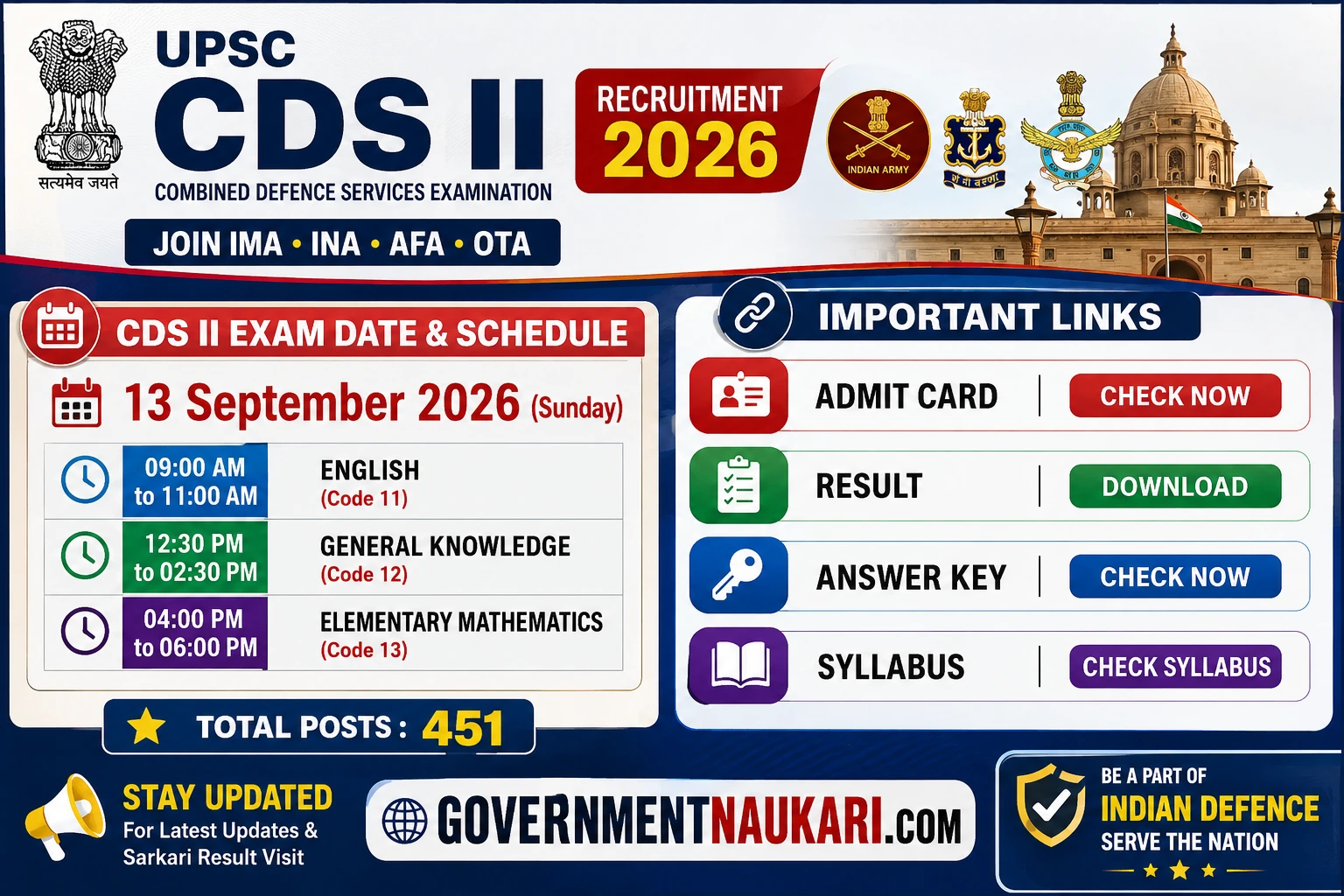
The UPSC CDS II Result 2026 was announced on 19 October 2026. Candidates who appeared in the Combined Defence Services Examination II 2026 can check the written result PDF through the official UPSC website. The examination was conducted on 13 September 2026. Candidates should download the result PDF and search for their roll number. इस page पर Sarkari Result 2026, Answer Key, Result और Sarkari Exam से जुड़ी latest updates देखें।
The Union Public Service Commission (UPSC) has announced the UPSC CDS II Result 2026, with the result notice dated 19 October 2026. Candidates can check the official result PDF and follow UPSC instructions for the next stage of selection. उम्मीदवार अपना roll number result PDF में check करें और आगे की प्रक्रिया के लिए official instructions देखें। GovernmentNaukari.com पर Sarkari Result, Sarkari Naukari, Answer Key और सरकारी भर्ती की जानकारी प्राप्त करें।
Candidates can check the important dates for the UPSC CDS II Sarkari Exam 2026 below.
| Event | Date |
|---|---|
| Online Apply Start Date | 20 May 2026 |
| Online Apply Last Date | 11 June 2026 |
| Last Date for Fee Payment | 11 June 2026 |
| CDS II Exam Date | 13 September 2026 |
| Admit Card | 03 September 2026 - Released |
| Answer Key | 16 September 2026 - As Previously Listed |
| Written Result | 19 October 2026 - Result Notice |
| Category | Application Fee |
|---|---|
| General / OBC / EWS | ₹200/- |
| SC / ST / All Female Candidates | ₹0/- |
| Payment Mode | |
| Debit Card, Credit Card, Internet Banking and other methods specified in the official notification. | |
| Resource | Link |
|---|---|
| Download UPSC CDS II Name Wise Result 2026 |
Click Here
Name Wise Result: 26 October 2026 |
| Check UPSC CDS II Result 2026 |
Click Here
Written Result: 19 October 2026 |
| Check UPSC CDS II Answer Key 2026 |
Click Here
Answer Key: Check Official UPSC Update |
| Download UPSC CDS II Admit Card 2026 |
Click Here
Admit Card Released: 03 September 2026 |
| Check Exam Schedule Notice |
Click Here
UPSC CDS II 2026 Exam Schedule PDF |
| Apply Online |
Click Here
Application Process Closed |
| Check Date Extension Notice |
Click Here
CDS II Date Extension Notice |
| Check Official Notification |
Click Here
UPSC CDS II 2026 Official Notification |
| UPSC Official Website |
Click Here
Union Public Service Commission Official Website |
The UPSC CDS II Age Limit 2026 varies according to the academy and course. The age eligibility is calculated with reference to 01 July 2027. Candidates must satisfy the prescribed date-of-birth and marital-status conditions for their selected entry.
| Academy | Age Limit | Date of Birth | Marital Status |
|---|---|---|---|
| Indian Military Academy (IMA) | 19–24 Years | 01 July 2003 to 01 July 2008 | Unmarried Male |
| Indian Naval Academy (INA) | 19–24 Years | 01 July 2003 to 01 July 2008 | Unmarried Male |
| Air Force Academy (AFA) | 20–24 Years | 01 July 2003 to 01 July 2007 | As prescribed for the course |
| Air Force Academy – Eligible CPL Holders | Up to 26 Years | 01 July 2001 to 01 July 2007 | Subject to AFA eligibility rules |
| Officers' Training Academy (OTA) – Men | 19–25 Years | 01 July 2002 to 01 July 2008 | Unmarried Male |
| Officers' Training Academy (OTA) – Women | 19–25 Years | 01 July 2002 to 01 July 2008 | Eligible unmarried women, issueless widows and issueless divorcees who have not remarried, subject to prescribed conditions |
Age Relaxation: The Air Force Commercial Pilot Licence provision is a specific age-related concession, not a general relaxation for all candidates. No additional age relaxation should be assumed unless permitted under the applicable CDS II 2026 rules.
Candidates should calculate their age using the exact date-of-birth conditions above. केवल 20 से 24 वर्ष की age range देखकर eligibility decide न करें, क्योंकि IMA, INA और OTA के age criteria अलग हैं.
The UPSC CDS II Recruitment 2026 has announced 451 tentative vacancies for admission to officer-training courses in the Indian Army, Indian Navy and Indian Air Force. The recruitment includes IMA, INA, AFA and OTA entries for eligible candidates.
| Academy / Course Name | Vacancies | Course Commencement |
|---|---|---|
|
Indian Military Academy (IMA), Dehradun 163rd DE Course |
100 | July 2027 |
|
Indian Naval Academy (INA), Ezhimala Executive Branch (General Service) / Hydro |
26 | July 2027 |
|
Air Force Academy (AFA), Hyderabad 222 F(P) Course |
32 | July 2027 |
|
Officers' Training Academy (OTA), Chennai – Men 126th SSC Non-Technical Course |
275 | October 2027 |
|
Officers' Training Academy (OTA), Chennai – Women 126th SSC Women Non-Technical Course |
18 | October 2027 |
| Total Vacancies | 451 | All five course entries combined |
Vacancy Calculation: IMA 100 + INA 26 + AFA 32 + OTA Men 275 + OTA Women 18 = 451 total vacancies. OTA accounts for 293 vacancies when the men's and women's entries are combined.
The vacancies are tentative and may be revised according to service requirements. NCC-related vacancies mentioned above are included within the respective academy totals; they should not be added again to the overall vacancy count.
Candidates looking for Sarkari Result 2026, defence recruitment, Sarkari Naukari and other government job updates can explore the latest updates on GovernmentNaukari.com.
To apply for the UPSC CDS II 2026 examination, candidates must hold the required educational qualification for their selected academy. IMA and OTA generally accept graduation in any discipline, whereas INA and AFA have additional qualification requirements.
| Academy | Required Educational Qualification |
|---|---|
| Indian Military Academy (IMA) | A degree from a recognised university or an equivalent qualification. Candidates from recognised graduation streams may apply if they satisfy the age, marital-status and other eligibility conditions. |
| Officers' Training Academy (OTA) | A degree from a recognised university or an equivalent qualification. Eligible graduates from any discipline may apply for the relevant SSC Non-Technical entry. |
| Indian Naval Academy (INA) | A degree in Engineering from a recognised university or institution for the notified Executive Branch (General Service) / Hydro entry. Candidates must also meet the academy's age and other conditions. |
| Air Force Academy (AFA) | A recognised bachelor's degree with Physics and Mathematics at the 10+2 level, or a Bachelor of Engineering / Bachelor of Technology degree, subject to the prescribed eligibility conditions. |
| Final-Year Graduation Students | Candidates studying in the final year or final semester may be eligible if they satisfy the prescribed conditions and submit proof of passing within the required deadline. Candidates must not have any disqualifying backlog or failure that prevents them from meeting the degree requirement. |
Candidates must meet the nationality conditions prescribed for CDS II. Eligible categories can include Indian citizens and specified categories of subjects of Nepal or persons of Indian origin who migrated from designated countries with the intention of permanently settling in India, subject to the applicable certificate requirements.
Candidates must meet the medical and physical standards applicable to their selected service. Medical fitness can include requirements relating to general health, vision, hearing and other service-specific standards. Air Force candidates must meet the applicable flying-branch medical standards where relevant.
Important: Graduation in any stream is generally accepted for IMA and OTA, but an engineering qualification is required for INA. AFA applicants must satisfy the prescribed Physics and Mathematics or engineering-degree conditions. Candidates must also meet nationality, age, marital-status, document and medical requirements for their chosen academy.
The UPSC CDS II Selection Process 2026 includes the written examination, Services Selection Board (SSB) assessment, medical examination and final merit/allocation. Candidates must qualify the applicable stages and satisfy academy-specific eligibility requirements. केवल written exam पास करना final selection की guarantee नहीं है.
| Stage | Selection Details |
|---|---|
| 1. Written Examination | IMA, INA and AFA: English, General Knowledge and Elementary Mathematics. OTA: English and General Knowledge only. |
| 2. SSB Interview | Stage I screening followed by Stage II psychological tests, GTO tasks, interview and conference for candidates who qualify the screening stage. |
| 3. Document Verification | Verification of date of birth, educational qualification, identity, academy-specific eligibility and other required certificates/documents. |
| 4. Medical Examination | Assessment by the authorised medical board against the applicable service medical standards, including vision, hearing, general health and physical fitness. |
| 5. Final Merit & Allocation | Merit based on the applicable written and SSB marks, subject to eligibility, medical fitness, preferences, vacancies and service rules. |
| 6. Academy Training | Selected candidates join the allotted academy and must successfully complete the prescribed training and fulfil applicable service requirements. |
| Assessment | Main Activities |
|---|---|
| Stage I – Screening | Officer Intelligence Rating (OIR) tests and Picture Perception and Discussion Test (PPDT), as applicable. |
| Psychological Tests | Tests such as the Thematic Apperception Test (TAT), Word Association Test (WAT), Situation Reaction Test (SRT) and Self-Description Test (SDT), according to the SSB procedure. |
| Group Testing Officer (GTO) | Group discussion, planning exercise, progressive group tasks, group obstacle activities, command task and other prescribed individual/group activities. |
| Personal Interview | Questions about education, family/background, interests, current affairs, motivation, decision-making and suitability for officer responsibilities. |
| Conference | The assessors review the candidate's overall performance and decide the recommendation outcome. |
SSB Marks: IMA, INA and AFA have 300 SSB marks each; OTA has 200 SSB marks. Candidates must qualify Stage I screening to continue to the subsequent SSB assessment stages.
| Academy | Written Marks | SSB Marks | Combined Maximum |
|---|---|---|---|
| Indian Military Academy (IMA) | 300 | 300 | 600 |
| Indian Naval Academy (INA) | 300 | 300 | 600 |
| Air Force Academy (AFA) | 300 | 300 | 600 |
| OTA Men | 200 | 200 | 400 |
| OTA Women | 200 | 200 | 400 |
Candidates should keep their original documents and the required self-attested photocopies ready. The SSB call-up instructions and official notification determine the exact documents and submission procedure.
| Document | Purpose / Important Note |
|---|---|
| SSB Call-Up Letter | Reporting instructions and candidate details for the SSB centre. |
| UPSC Admit Card / Exam Records | Keep the examination admit card and other records if required by the call-up instructions. |
| Class 10 Certificate and Marksheet | Proof of date of birth and other recorded particulars, as prescribed. |
| Class 12 Marksheet and Certificate | Academic records, including Physics and Mathematics details where relevant to AFA eligibility. |
| Graduation Degree / Marksheet | Proof of the required bachelor's degree or qualifying academic status. |
| Engineering Degree / Records | Relevant qualification proof for INA and other applicable entries. |
| Government Photo ID | Valid identity document as specified in the instructions. |
| Photographs | Recent photographs in the quantity and format requested by the SSB centre. |
| Category / Other Certificates | Any certificate or supporting record specifically required under the applicable rules. |
| Additional Service-Specific Records | For example, a valid Commercial Pilot Licence or other evidence where applicable and specifically required. |
CDS does not prescribe one universal running test for every candidate as a separate written-exam stage. Candidates must, however, satisfy the medical and physical standards applicable to their academy and service. Medical assessment may cover general health, height and weight standards, vision, hearing, limbs and joints, cardiovascular and respiratory health, and other prescribed parameters.
| Medical / Physical Area | What Candidates Should Know |
|---|---|
| Height and Weight | Must comply with the applicable academy/service standards and permitted variations. Requirements can differ by service, sex and other notified factors. |
| Vision and Eyesight | Visual acuity, colour perception and other eye conditions are assessed under the applicable service-specific rules. Air Force flying duties may have stricter requirements. |
| Hearing | Hearing is assessed against the prescribed medical standards. |
| General Medical Fitness | The board may examine cardiovascular, respiratory, musculoskeletal and other health parameters and any condition affecting service suitability. |
| Orthopaedic Assessment | Posture, joints, limbs, movement and relevant musculoskeletal conditions may be assessed. |
| Dental and Other Checks | Dental fitness and additional medical investigations may be conducted as required by the authorised board. |
| Physical Conditioning | Regular running, endurance, strength, mobility and healthy sleep habits can help prepare for academy training. Personal training goals do not replace official medical standards. |
Important Medical Note: There is no single height, weight, eyesight or running requirement that should be assumed for every CDS entry. Exact limits and permitted conditions must be checked in the official CDS II 2026 notification and the applicable service medical standards. Do not rely on unofficial fitness charts alone.
The final merit process considers the marks prescribed for the written examination and SSB assessment. Selection is subject to eligibility, medical fitness, academy preferences, available vacancies and the applicable rules. A recommendation or high score alone does not guarantee admission. Candidates must meet all required conditions before joining the academy.
Selection Summary: Written Exam → SSB Assessment → Document and Eligibility Checks → Medical Examination → Final Merit and Allocation → Academy Training. सभी stages की तैयारी करें और official notification तथा SSB instructions को प्राथमिकता दें.
The UPSC CDS II 2026 written examination was scheduled for 13 September 2026. It consists of objective-type papers conducted in the prescribed offline format. IMA, INA and AFA candidates take three papers, whereas OTA candidates take two papers. हर paper की अवधि 2 hours होती है.
| Academy / Entry | Subject | Duration | Maximum Marks |
|---|---|---|---|
| IMA / INA / AFA | English | 2 Hours | 100 |
| General Knowledge | 2 Hours | 100 | |
| Elementary Mathematics | 2 Hours | 100 | |
| IMA / INA / AFA Total | 3 Papers – 6 Hours | 300 | |
| OTA Men / Women | English | 2 Hours | 100 |
| General Knowledge | 2 Hours | 100 | |
| OTA Total | 2 Papers – 4 Hours | 200 | |
| Exam Feature | Details |
|---|---|
| Question Type | Objective-type multiple-choice questions (MCQs). |
| Examination Mode | Offline written examination as prescribed by UPSC. |
| English | 100 marks; 2 hours. |
| General Knowledge | 100 marks; 2 hours. |
| Elementary Mathematics | 100 marks; 2 hours; not required for OTA. |
| Negative Marking | One-third of the marks assigned to a question are deducted for each incorrect answer under the prescribed scheme. |
| Unanswered Questions | No penalty for a question left unanswered. |
| Qualifying Standard | Candidates must meet the qualifying standards prescribed by UPSC and the applicable service requirements. |
Negative Marking Example: If a question carries 1 mark, an incorrect answer attracts a deduction of one-third mark. If a question carries a different mark value, the deduction is calculated according to the prescribed fraction for that question. इसलिए बिना सोचे-समझे answers mark करने से बचें.
| Academy | Written Exam | SSB Interview | Combined Maximum |
|---|---|---|---|
| Indian Military Academy (IMA) | 300 | 300 | 600 |
| Indian Naval Academy (INA) | 300 | 300 | 600 |
| Air Force Academy (AFA) | 300 | 300 | 600 |
| Officers' Training Academy (OTA) Men | 200 | 200 | 400 |
| Officers' Training Academy (OTA) Women | 200 | 200 | 400 |
The SSB is a separate assessment stage and is not another objective written paper. Candidates who qualify Stage I screening proceed to the subsequent assessment stages according to the SSB procedure.
| Stage / Activity | Assessment Details |
|---|---|
| OIR Tests | Verbal and non-verbal reasoning and officer intelligence assessment. |
| PPDT | Picture-based story writing and discussion as part of screening. |
| Psychological Tests | Responses, personality-related indicators, situation handling and thought process. |
| GTO Tasks | Group discussion, planning, teamwork, leadership and individual/group activities. |
| Personal Interview | Education, personal background, interests, general awareness, motivation and suitability. |
| Conference | Overall review and recommendation decision by the board. |
Note: The official UPSC notification, question-paper instructions and SSB call-up letter prevail wherever they differ from a general exam guide. यह UPSC CDS II Sarkari Exam 2026 pattern candidates को written exam और SSB दोनों की तैयारी समझने में मदद करता है.
The UPSC CDS II Syllabus 2026 covers English, General Knowledge and Elementary Mathematics. IMA, INA and AFA candidates must prepare all three subjects, while OTA candidates take English and General Knowledge only. नीचे detailed topic-wise preparation guide दी गई है. Candidates should cross-check the official syllabus and notification for the prescribed scope.
| Topic | Detailed Areas to Prepare |
|---|---|
| Reading Comprehension | Reading passages, central idea, supporting details, inference, conclusion, tone, context-based meanings and understanding the author's point. |
| Grammar and Usage | Parts of speech, nouns, pronouns, verbs, adjectives, adverbs, articles, prepositions, conjunctions, tenses, subject-verb agreement and sentence structure. |
| Sentence Correction | Grammatical errors, incorrect expressions, sentence improvement, correct word usage and identifying the most appropriate sentence. |
| Vocabulary | Synonyms, antonyms, word meanings, commonly confused words, spelling, one-word substitutions where applicable and vocabulary in context. |
| Idioms and Phrases | Meanings of common idioms, phrases and expressions; usage in sentences and context-based interpretation. |
| Ordering of Words | Rearranging words to form grammatically correct and meaningful sentences. |
| Ordering of Sentences | Sentence sequencing, paragraph organisation, logical flow and coherent arrangement of ideas. |
| Fill in the Blanks | Appropriate words, grammar-based completion, vocabulary, prepositions, conjunctions and contextual choices. |
| Sentence Completion | Choosing a suitable phrase or expression to complete a sentence while maintaining correct meaning and grammar. |
| Usage and Expression | Clear written expression, correct usage, comprehension of English and other language questions within the prescribed examination scope. |
The General Knowledge paper broadly tests awareness of current events and everyday scientific understanding, along with Indian history and geography. Questions may cover different levels of difficulty. Candidates should study concepts rather than relying only on short current-affairs lists.
| Subject | Detailed Topics |
|---|---|
| Current Affairs | Important national and international events; government policies and initiatives; awards and honours; appointments; books and authors; important days; sports; science and technology developments; defence news; international organisations and summits. |
| Indian History | Ancient, medieval and modern India; major dynasties; social and religious movements; important rulers; British expansion; Revolt of 1857; national movement; freedom struggle; major leaders; constitutional developments before independence and important historical events. |
| Geography – Physical | Earth structure; latitude and longitude; rotation and revolution; landforms; mountains, plateaus and plains; atmosphere; climate; weather; winds; rainfall; oceans; tides and natural resources. |
| Indian Geography | Physical divisions of India; Himalayas; plains; plateau regions; rivers and drainage; monsoon; soils; forests; agriculture; minerals; energy resources; industries; transport; population and major geographical regions. |
| World Geography | Continents and oceans; important countries and capitals; major rivers and mountains; climate zones; deserts; natural resources; world regions and basic geographical relationships. |
| Indian Polity and Constitution | Constitutional framework; Preamble; fundamental rights and duties; Directive Principles; President; Vice-President; Prime Minister; Council of Ministers; Parliament; Supreme Court; High Courts; federal structure; elections; constitutional bodies and local government. |
| Economics | Basic economic concepts; national income; GDP; inflation; banking; money and credit; taxation; budget basics; unemployment; poverty; agriculture and industry; economic planning and important Indian economic developments. |
| Physics | Units and measurements; motion; force; work, energy and power; gravitation; pressure; density; heat and temperature; sound; light; reflection and refraction; mirrors and lenses; electricity; magnetism; simple machines and common physical phenomena. |
| Chemistry | Matter; elements and compounds; atoms and molecules; mixtures; physical and chemical changes; acids, bases and salts; metals and non-metals; oxidation; combustion; common chemicals; fuels; water and air; everyday applications of chemistry. |
| Biology | Cell and tissues; plant and animal life; human body systems; nutrition; digestion; respiration; blood circulation; excretion; nervous system; reproduction; diseases; immunity; vitamins; deficiency diseases and basic health science. |
| Environment and Ecology | Ecosystems; food chains and food webs; biodiversity; wildlife conservation; pollution; climate change; renewable resources; conservation; national parks and protected areas; environmental challenges. |
| Defence Awareness | Indian Army, Navy and Air Force; ranks and commands at a general-awareness level; important military exercises; defence technology; major defence developments and relevant national security topics. |
| General Science | Scientific discoveries and applications in everyday life; basic health and hygiene; common scientific instruments; inventions; technology developments and fundamental concepts from school-level science. |
Elementary Mathematics is required for IMA, INA and AFA candidates, but it is not part of the OTA written examination. Preparation should focus on fundamentals, formula application, calculation speed and accuracy. The official UPSC syllabus determines the final scope.
| Topic | Detailed Topics to Prepare |
|---|---|
| Arithmetic and Number System | Natural numbers, integers, rational numbers, real-number basics, decimal fractions, elementary operations, divisibility, factors, multiples, HCF, LCM, squares, square roots and simplification. |
| Ratio and Proportion | Ratios, proportions, direct and inverse variation, comparison of quantities and practical applications. |
| Percentage | Percentage calculations, increase and decrease, successive percentage changes and percentage-based applications. |
| Profit, Loss and Discount | Cost price, selling price, profit, loss, marked price, discount and related calculations. |
| Interest | Simple interest, compound interest, principal, rate, time and basic comparison problems. |
| Time and Work | Work rates, combined work, efficiency, work completed in a given period and related numerical problems. |
| Time, Speed and Distance | Speed, distance, time, average speed, relative speed and basic journey-based problems. |
| Algebraic Operations | Basic algebraic expressions, operations on terms, factors, remainders, identities and simplification. |
| Polynomials and Equations | Linear equations, simultaneous linear equations, quadratic equations, roots and elementary algebraic problems. |
| Sets and Number Relationships | Elementary set concepts, notation and simple relationships where included in the prescribed syllabus. |
| Geometry – Lines and Angles | Lines, angles, parallel lines, intersecting lines, angle relationships and basic geometric properties. |
| Triangles | Types of triangles, congruence, similarity, angle properties, sides, perimeter and standard triangle relationships. |
| Quadrilaterals and Polygons | Squares, rectangles, parallelograms, rhombuses, trapeziums, polygon properties and angle relationships. |
| Circles | Radius, diameter, chord, arc, circumference, angles and standard properties of circles. |
| Trigonometry | Sine, cosine and tangent; standard angles; trigonometric identities; basic ratios; heights and distances; and elementary applications of trigonometry. |
| Mensuration – 2D | Perimeter and area of squares, rectangles, triangles, parallelograms, trapeziums and circles; composite shapes and related calculations. |
| Mensuration – 3D | Surface area and volume of cubes, cuboids, cylinders, cones, spheres and other standard solids within the prescribed syllabus. |
| Statistics | Collection and classification of data; frequency distributions; tables; graphs; histograms; bar charts; pie charts; averages and interpretation of statistical information. |
| Subject | How to Prepare |
|---|---|
| English | Practise grammar and vocabulary daily, read passages, revise idioms and solve timed comprehension and sentence-correction questions. |
| General Knowledge | Revise history, geography, polity, economics and general science. Keep up with current affairs and revise key facts regularly. |
| Elementary Mathematics | Master formulas and fundamentals, practise calculations and solve topic-wise questions before attempting full-length timed papers. |
| Previous-Year Papers | Use official previous-year question papers to understand question styles, topic coverage and time-management requirements. |
| Mock Tests | Attempt papers under the prescribed time limit and review incorrect answers to improve accuracy. |
| SSB Preparation | Build communication, reasoning, awareness, teamwork and physical conditioning habits. Prepare honestly instead of memorising scripted responses. |
UPSC CDS II Sarkari Exam 2026: Candidates should combine subject-wise preparation with mock tests, revision and SSB readiness. सही strategy, regular practice और accuracy written exam में मदद करते हैं, लेकिन final selection के लिए SSB, medical fitness और सभी eligibility conditions भी पूरी करनी होती हैं.
Candidates should keep their identification and educational details organised for the examination and subsequent selection stages. CDS recruitment में document verification महत्वपूर्ण है, इसलिए सभी records में name, date of birth और अन्य details सही होनी चाहिए.
| Document / Information | Purpose |
|---|---|
| UPSC CDS II Admit Card | Examination entry and candidate details. |
| Valid Photo Identity Proof | Identity verification as prescribed in the examination instructions. |
| Class 10 Certificate / Mark Sheet | Date-of-birth verification, where required. |
| Graduation Certificate / Mark Sheets | Verification of the required educational qualification. |
| Engineering Degree / Relevant Records | Required for candidates claiming the INA educational qualification. |
| Class 12 Physics and Mathematics Records | Relevant for candidates applying to AFA through the applicable degree route. |
| Recent Photograph | As required by the examination or selection authority. |
| Signature | As required for application and verification purposes. |
| Category or Other Supporting Certificate | Where applicable under the prescribed rules. |
| Commercial Pilot Licence | For eligible AFA candidates claiming the applicable CPL-related age provision. |
| Other Eligibility Documents | Nationality, marital-status or other records where required. |
Candidates should retain their admit card, registration details and educational records safely. SSB assessment and academy reporting may require original certificates and additional documents. The exact requirements depend on the candidate's entry and selection stage.
Important: Carry only the documents requested in the applicable instructions. Candidates should keep original certificates safe and maintain copies of important records for later verification.
Candidates selected through UPSC CDS II Recruitment 2026 undergo training at their allotted academy. The prescribed training stipend is generally ₹56,100 per month during eligible pre-commission training. After commissioning, officers receive pay according to rank, pay level and applicable service rules.
| Rank / Stage | Pay Level | Basic Pay per Month |
|---|---|---|
| Cadet Training Stipend | During eligible training | ₹56,100 |
| Lieutenant / Equivalent Entry Rank | Level 10 | ₹56,100 – ₹1,77,500 |
| Captain / Equivalent Rank | Level 10B | ₹61,300 – ₹1,93,900 |
| Major / Equivalent Rank | Level 11 | ₹69,400 – ₹2,07,200 |
| Lieutenant Colonel / Equivalent Rank | Level 12A | ₹1,21,200 – ₹2,12,400 |
| Colonel / Equivalent Rank | Level 13 | ₹1,30,600 – ₹2,15,900 |
| Allowance / Benefit | Details |
|---|---|
| Military Service Pay (MSP) | Generally ₹15,500 per month for eligible officers in applicable ranks, subject to service rules. |
| Dearness Allowance (DA) | Payable according to the applicable government rate. |
| Transport Allowance | Payable where admissible under the applicable rules. |
| Field / Risk / Hardship Allowances | May be payable for eligible duties, locations and postings. |
| Accommodation Benefits | Government accommodation or other applicable housing benefits, subject to entitlement and availability. |
| Medical Facilities | Medical facilities under the applicable service rules. |
| Leave and Welfare Benefits | Leave and other service benefits according to the applicable rules. |
Salary Note: The amounts shown are pay-matrix figures and do not represent a guaranteed in-hand salary. Actual monthly earnings depend on rank, allowances, posting, deductions and current service rules. Training stipend is different from commissioned-officer pay.
The UPSC CDS II Admit Card 2026 was released on 03 September 2026, and the written examination was scheduled for 13 September 2026. Candidates should retain their examination documents and follow the applicable instructions for the result and subsequent selection stages.
| Important Detail | Information |
|---|---|
| Examination Date | 13 September 2026 |
| Admit Card Release | 03 September 2026 |
| English Paper | 09:00 AM – 11:00 AM |
| General Knowledge Paper | 12:30 PM – 02:30 PM |
| Elementary Mathematics Paper | 04:00 PM – 06:00 PM |
| Exam Mode | Offline written examination |
| Question Type | Objective-type multiple-choice questions |
ध्यान दें: Candidates should keep their documents safe even after the written examination, as they may be needed during SSB, document verification and academy reporting.
GovernmentNaukari.com पर candidates को Sarkari Result 2026, Sarkari Naukari, Sarkari Vacancy, Sarkari Exam, Admit Card, Answer Key और Government Jobs की जानकारी मिलती है. नीचे दिए गए internal links से latest recruitment notifications, examination updates और results देख सकते हैं.
| Category / Related Recruitment | Page Link |
|---|---|
| Latest Government Jobs | Latest Sarkari Naukari |
| Sarkari Admit Card | Latest Admit Cards |
| Sarkari Result 2026 | Latest Sarkari Result |
| Answer Key | Latest Answer Keys |
| Government Schemes | Government Schemes |
| UPSC NDA II 2026 | UPSC NDA II 2026 |
| UPSC Recruitment 2026 – 11 Posts | UPSC Recruitment 2026 |
| SSC CGL 2026 | SSC CGL Recruitment 2026 |
| SSC CPO SI 2026 | SSC CPO SI 2026 |
| RRB Technician 2026 | RRB Technician Recruitment 2026 |
| UPSSSC Excise Constable 2026 | UPSSSC Excise Constable 2026 |
| UPSSSC Veterinary Pharmacist 2026 | UPSSSC Veterinary Pharmacist 2026 |
| UPESSC PRT / Assistant Teacher 2026 | UPESSC PRT Assistant Teacher 2026 |
| UP PGT Teacher 2026 | UP PGT Teacher Recruitment 2026 |
| UPSSSC Ayurvedic Pharmacist | UPSSSC Ayurvedic Pharmacist |
| SBI Junior Associates Clerk 2026 | SBI Clerk Recruitment 2026 |
| NEET PG 2026 | NEET PG 2026 |
| Bihar Police SI 2026 | Bihar Police SI Recruitment 2026 |
| Rajasthan SET 2026 | Rajasthan SET 2026 |
| NICL Assistant 2026 | NICL Assistant Recruitment 2026 |
| UPSSSC PET 2026 | UPSSSC PET 2026 |
Candidates preparing for defence and other competitive examinations can use these internal links to explore related government recruitment updates. GovernmentNaukari.com publishes information about Sarkari Result, Govt Jobs, Sarkari Admit Card, exam dates and recruitment notices.
| Question | Answer |
|---|---|
| When was the UPSC CDS II 2026 examination conducted? | The UPSC CDS II 2026 written examination was conducted on 13 September 2026. |
| When was the UPSC CDS II Result 2026 released? | The result update for this page is dated 19 October 2026. Candidates can access the result PDF through the result link included in the post. |
| How many vacancies are available in UPSC CDS II 2026? | The total notified vacancy count is 451, comprising IMA 100, INA 26, AFA 32, OTA Men 275 and OTA Women 18. |
| What is the UPSC CDS II exam pattern for IMA, INA and AFA? | There are three papers: English, General Knowledge and Elementary Mathematics. Each paper carries 100 marks and lasts two hours. The total written examination is 300 marks. |
| What is the UPSC CDS II exam pattern for OTA? | OTA candidates take English and General Knowledge. Each paper carries 100 marks and lasts two hours, making the written examination 200 marks. |
| Is negative marking applicable in the CDS examination? | Yes. One-third of the marks assigned to a question are deducted for an incorrect answer. Unanswered questions do not attract a penalty under the standard marking scheme. |
| What is the UPSC CDS II selection process? | The selection process includes the written examination, SSB Intelligence and Personality Test, medical examination, document verification and final merit/allocation according to the applicable rules. |
| What is the educational qualification for CDS II 2026? | IMA and OTA generally require a recognised bachelor's degree. INA requires an engineering degree. AFA requires a recognised degree with Physics and Mathematics at the 10+2 level or an eligible engineering degree, subject to the applicable conditions. |
| What is the age limit for UPSC CDS II 2026? | Age and date-of-birth conditions vary by academy and course. Candidates must satisfy the specific age and marital-status conditions for their chosen entry. |
| What is the training stipend for CDS candidates? | The prescribed training stipend is generally ₹56,100 per month during eligible pre-commission training, subject to the applicable rules. |
| What is the starting basic salary after commissioning? | The basic pay for a Lieutenant or equivalent entry rank is ₹56,100 per month at Pay Level 10. Eligible officers may receive MSP and other admissible allowances. |
| Can women apply through UPSC CDS II 2026? | Yes. The notified OTA Women entry includes 18 vacancies. Women candidates must satisfy the prescribed educational, age, marital-status and other eligibility conditions. |
| When was the UPSC CDS II Admit Card 2026 released? | The admit card was released on 03 September 2026. |
| Where can I find the UPSC CDS II Answer Key 2026? | Candidates can use the Answer Key link included in the post to access the available answer-key information and compare responses where an official key has been published. |
| Where can I check other Sarkari Result 2026 updates? | Visit the Sarkari Result section on GovernmentNaukari.com for other recruitment results and updates. |
Disclaimer: Vacancy distribution, pay, eligibility and selection rules are subject to the applicable UPSC notification and service regulations. Result and answer-key information should correspond to the actual notices linked on the page.
This page covers the UPSC CDS II Result 2026, answer key updates, exam pattern, full syllabus, eligibility, academy-wise vacancies, selection process and salary details. Candidates preparing for a defence career can use the information to understand the written examination and subsequent selection stages.
GovernmentNaukari.com provides updates on Sarkari Result 2026, Sarkari Naukari, Sarkari Exam, government recruitment, admit cards and answer keys.